Tracking · Updated August 2026 — Last verified August 2026
Here’s how to track Pakistani passport application status in 2026 — including what’s changed under the new Shikra monitoring system, the home delivery option, and the switch to cashless fees. Track your application on the DGIP e-Services portal using your token number or CNIC, or send your token number by SMS to 9988.
Quick Answer
To track Pakistani passport application status, use the DGIP e-Services portal with your token number or CNIC, or text your token number to 9988.
Since January 2026, all tracking runs through “Shikra” — a real-time monitoring dashboard the Ministry of Interior launched to oversee every application from submission through printing to dispatch, domestically and at overseas missions. A 24/7 monitoring room and call centre now back up the portal and SMS options.
Overseas applicants track through their mission’s own portal or the same DGIP system, now under the same real-time oversight.
Tracking status can be one of the more confusing parts of the process, mostly because statuses don’t always update the way applicants expect. This guide covers how to check status, what’s changed under Shikra, and how to interpret what you see.
What Is “Shikra,” and Why Does It Matter to Track Pakistani Passport Application?
Shikra (Secure Hybrid Intelligence for Knowledge-based Response Analytics) is the real-time digital dashboard Interior Minister Mohsin Naqvi inaugurated in January 2026 at DGIP headquarters.
It doesn’t replace the tools you already use to track Pakistani passport application — the portal and SMS system still work the same way — but it’s the infrastructure now running behind them. Shikra monitors:
- Every application stage, from submission to final dispatch, domestically and at Pakistani missions abroad
- Passport office crowding, so DGIP can identify and respond to high-traffic periods automatically
- Printing machine status and backlogs, part of why your status can jump multiple stages between checks
- Staff and departmental performance, feeding a digital dashboard used internally by DGIP
The dashboard itself is an internal DGIP tool, not something you log into directly. What you get as an applicant is the benefit of it: more consistent SMS/portal updates and the new call centre described below. For more detail, see our full Shikra passport monitoring system guide.
Ways to Track Pakistani Passport Application Status
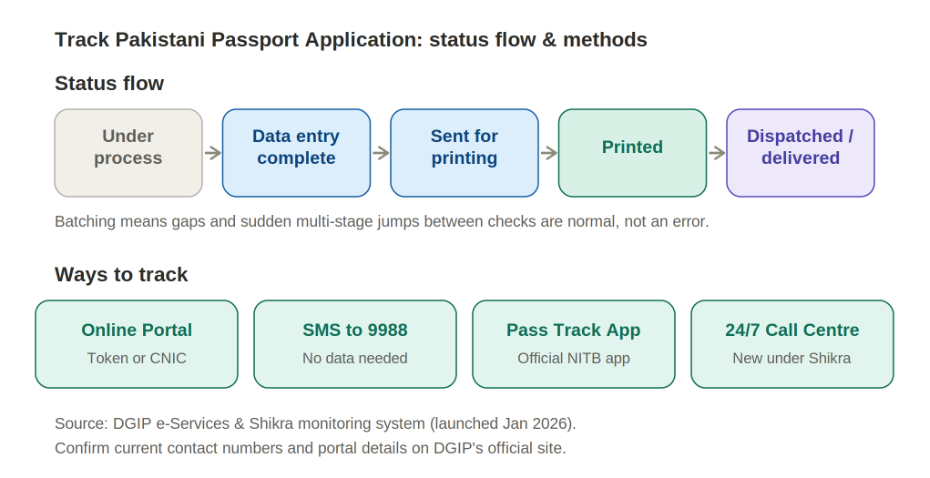
- Online Portal — Go to the DGIP tracking portal, enter your token number or CNIC, and see your status update in real time as your file moves.
- SMS Tracking — Text your token number to 9988 (see DGIP’s official SMS tracking page). Works on any local network, no data needed.
- Pass Track App — DGIP’s official mobile app (developed by NITB) offers the same status lookup on your phone, plus complaint submission. If your app-based submission runs into an issue, our passport application problems guide walks through common fixes.
- 24/7 Call Centre — New as of the Shikra rollout. If your status hasn’t moved and you want a human answer rather than refreshing the portal, this is now the fastest first step, ahead of an in-person RPO visit.
All of these draw from the same underlying system, so which one you use to track Pakistani passport application is mostly a matter of convenience — SMS tracking is particularly handy without reliable internet, and the call centre is best reserved for genuine delays rather than routine day-to-day checking.
What Each Status Means
| Status | What It Means |
| Under process | Application received, verification in progress |
| Data entry complete | Biometric and personal data confirmed in the system |
| Sent for printing | Application approved, booklet being printed |
| Printed | Booklet printed, awaiting dispatch to your office |
| Ready for collection / dispatched | Available for pickup at your RPO, or on its way by courier if you opted into home delivery |
Understanding this sequence helps you gauge where your application actually stands rather than just watching for the final “ready” status when you track Pakistani passport application. A file that has reached “data entry complete” has cleared the verification stage — everything after that point is comparatively mechanical (printing and dispatch) rather than involving further review.
Passport Home Delivery: What “Dispatched” Can Now Mean
DGIP launched “Passport Aapki Dehleez Par” (Passport at Your Doorstep) in partnership with TCS for domestic deliveries and DHL for applicants at overseas missions.
If you opt into this at the time of application, your final status while you track Pakistani passport application still shows as “dispatched” — but instead of collecting your passport in person at the RPO, it’s couriered directly to your home or a preferred address, for a nominal courier fee.
This doesn’t change how you track your application — the portal, SMS, and Pass Track app all work exactly the same way. It changes what happens after “dispatched”: you’d track the courier’s own delivery confirmation (via TCS or DHL) rather than making a collection trip.
Why Does Tracking Status Seem to Stall?
Most “stuck” statuses aren’t actually stuck — they reflect batching. DGIP processes verification and printing in batches rather than one application at a time, so your file can sit at “under process” for several days even while progressing internally, then jump straight to “printed” without visibly passing through intermediate stages.
This is also part of what Shikra is specifically designed to reduce — its Network Management System monitors backlogs and machinery status in real time, and automatically flags office-level crowding.
This is intended to shrink exactly this kind of invisible batching delay over time. That said, the batching pattern itself hasn’t disappeared: checking status daily and seeing no change, then suddenly seeing it jump two or three stages at once, is still normal rather than a sign anything went wrong when you track Pakistani passport application status.
When Should You Follow Up on Your Application?
“Under process” for longer than your selected processing window doesn’t necessarily mean a problem — it’s the default status shown for the entire verification stage. A useful rule of thumb: give your status one full week of grace beyond your quoted processing window before treating it as worth escalating.
If that week passes with no movement, follow up in this order:
1. Call the 24/7 helpline introduced under Shikra — this is now the fastest way to get a real answer without traveling to an office. (Confirm the current number on DGIP’s official site, since contact details can change.)
2. Contact the Regional Passport Office directly, quoting your token number, if the call centre can’t resolve it — see our RPO application process guide or regional office directory if you need contact details.
3. Visit in person only if neither of the above resolves it and your status hasn’t moved at all for more than a week past your expected date. If something’s genuinely gone wrong, our passport complaint process covers next steps.
Tracking From Overseas
Applications submitted through a Pakistani mission abroad can usually be tracked the same way, using the token number issued at submission. Some missions also run their own status pages — check with your specific embassy or consulate if the DGIP portal shows no record.
Overseas applicants who want to track Pakistani passport application status from abroad follow an identical process to domestic applicants. Renewing from the UK or Saudi Arabia specifically? See our dedicated guides for renewing in the UK or renewing in Saudi Arabia.
Overseas applicants have historically seen slower timelines than domestic applicants, since mission-routed applications involve an additional verification layer before entering the standard DGIP processing pipeline.
This is one of the areas Shikra explicitly targets — its stated scope includes monitoring mission-submitted applications globally with the same real-time oversight as domestic ones.
If you’re unsure whether NICOP or POC applies to your situation as an overseas applicant, our NICOP vs POC guide clarifies the difference.
Emergency Travel Documents Are Now Fully Digital
As part of the same Shikra rollout, DGIP fully digitized the Emergency Travel Document (ETD) issuance process.
If you’re tracking an ETD rather than a standard passport, expect it to move through the same kind of digital, real-time oversight — worth knowing if you’re dealing with a lost or damaged passport situation, or need an emergency travel document urgently.
Part of a Broader Digitization Push
Shikra and home delivery aren’t isolated changes — they’re part of the same push, alongside cashless fee payment, which became mandatory from July 1, 2026. Passport fees are now paid via QR code through banking apps and digital wallets rather than cash or a bank deposit at NBP.
It doesn’t affect how you track Pakistani passport application once it’s submitted, but if your status seems stuck at an early stage, an unpaid or incorrectly-paid fee is worth ruling out first — see our passport fee 2026 guide and online fee payment guide if you haven’t paid digitally yet.
This is also part of the same wave that brought full e-passport adoption in 2026.
Tracking Multiple Family Members
You’ll need each person’s individual token number or CNIC — there’s no combined household lookup, even if the whole family applied together on the same day.
If you need to track Pakistani passport application status for several family members, keep each token receipt separate and easy to locate, since there’s no shortcut for checking several applications at once through a single reference number.
Practical Note
“Under process” for longer than your selected processing window doesn”’t necessarily mean a problem — it”’s the default status shown for the entire verification stage.
Since the Shikra rollout, it”’s worth trying the 24/7 call centre before an in-person visit if the status hasn”’t moved at all for more than a week past your expected date. This is one of the more useful habits to build when you track Pakistani passport application, since it saves a wasted trip more often than not.
Frequently Asked Questions
What is the Shikra system, and does it change how I track Pakistani passport application?
Shikra is DGIP’s real-time monitoring dashboard, launched in January 2026, that oversees every application from submission to dispatch. It doesn’t replace the portal or SMS tracking you already use — it’s the infrastructure now running behind them, plus it added a 24/7 call centre as a new follow-up option.
My status hasn’t changed in over a week — what should I do?
Try the 24/7 call centre introduced under Shikra first, then contact the Regional Passport Office directly, quoting your token number, if that doesn’t resolve it — status pages aren’t always updated in real time.
Can I track without a token number?
Yes, most tracking tools also accept your CNIC number as an alternative.
Does SMS tracking cost anything?
Standard network SMS charges apply; the service itself has no extra fee.
Why did my status skip straight from “under process” to “printed”?
DGIP updates statuses in processing batches rather than continuously, so intermediate stages can complete between your checks without showing separately.
Can I track more than one family member’s application with one method?
You’ll need each person’s individual token number or CNIC — there’s no combined household lookup.
Is the online tracking status the same as what the office counter shows?
Usually yes, but the counter’s internal system can be a day or so ahead of what’s reflected online, so a phone call can sometimes give a more current answer.
Is there an official app to track Pakistani passport application status, besides the website and SMS?
Yes — Pass Track, DGIP’s official mobile app developed by NITB, offers the same status lookup plus complaint submission.
Does the Shikra system cover overseas/mission-submitted applications too?
Yes. Its stated scope explicitly includes real-time monitoring of applications submitted through Pakistani missions abroad, alongside domestic ones.
Can my passport be delivered to my home instead of collecting it at the office?
Yes. Under “Passport Aapki Dehleez Par,” DGIP delivers passports directly to your address via TCS domestically or DHL for overseas missions, for a nominal courier fee. Your tracking status still shows “dispatched” — you’d then watch for a courier notification instead of visiting the RPO.
Do I still pay passport fees in cash?
No. As of July 1, 2026, all passport fee payments are cashless — pay via QR code through a banking app or digital wallet. Cash and bank-deposit payments at NBP are no longer accepted. This is unrelated to how you track Pakistani passport application status once it’s submitted, but an unpaid fee is a common reason a status stalls early.
Bottom Line
To track Pakistani passport application in 2026, the mechanics are simple — a token number or CNIC gets you a status through the portal, SMS, or the Pass Track app — but interpreting what that status means still takes a little patience.
The Shikra system, launched in January 2026, backs all of this with real-time monitoring and a new 24/7 call centre, and home delivery via TCS or DHL means “dispatched” no longer always requires an office visit.
Batching still means gaps and sudden jumps are normal, and a status is generally only worth escalating once it’s stalled well past your expected date, not the moment the clock hits your quoted window.
For everything else passport-related, our homepage has the complete guide library, or start with new passport applications if you haven’t applied yet.