Overseas · Updated August 2026 — Last verified August 2026
Quick Answer
The difference between NICOP and POC is a question that trips up most overseas Pakistanis at least once. Here’s the short version: NICOP is for Pakistanis living abroad who still hold Pakistani citizenship. POC is for people of Pakistani origin who have taken foreign citizenship and lost their Pakistani nationality but want long-term entry rights. Both are now applied for exclusively through NADRA’s Pak Identity online portal or the PakID mobile app — these services are no longer processed at Pakistani missions or consulates, which now only offer limited in-person support for applicants stuck on an existing online submission.
Confusing these two documents is one of the more common mistakes overseas Pakistanis make, largely because both are aimed at the same broad group — people with a Pakistani background living outside the country. Getting the difference between NICOP and POC wrong can cost you application fees and weeks of delay, so it comes down entirely to citizenship status, not where you live or which passport you’re currently traveling on.
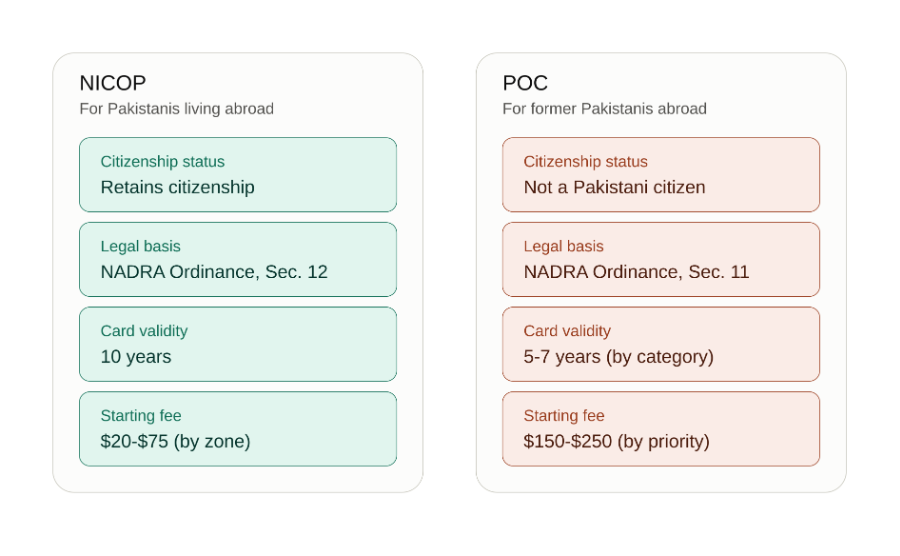
Difference between NICOP and POC comparison infographic
Difference Between NICOP and POC: At a Glance
| Card | Who It’s For | Citizenship Status |
| NICOP | Pakistanis living abroad | Retains Pakistani citizenship |
| POC | Former Pakistanis who took foreign citizenship | Not a Pakistani citizen, but granted long-term entry rights |
The single question that determines which of these applies to you is: do you currently hold Pakistani citizenship, or did you give it up when you naturalized elsewhere? If you still hold Pakistani citizenship alongside a foreign one, you’re in NICOP territory. If you formally lost Pakistani citizenship, POC is the relevant document.
Difference Between NICOP and POC: How NICOP Works
Legal basis: Issued under Section 12 of the NADRA Ordinance, 2000, to Pakistani citizens residing abroad.
Card Types
| Type | Status |
| Standard NICOP (Teslin-based) | Discontinued |
| Smart NICOP (embedded microchip) | Active |
| NICOP with QR Code | Active |
| NICOP (Polycarbonate) | Active |
The Polycarbonate shift mirrors the same material upgrade happening on the Pakistani e-Passport — both moves are part of NADRA’s broader push toward chip-based, tamper-resistant identity documents.
Eligibility & Rules
- Issued to Pakistani citizens living or working abroad, dual citizens, intending non-residents, or children of Pakistani citizens born abroad
- Renewal (Rule 12, NADRA NIC Rules 2002): apply any time, but no later than one month after expiry
- Update/Modify (Rule 13, NADRA NIC Rules 2022): available for correcting or changing card details
- Reprint/Duplicate (Rule 13, NADRA NIC Rules 2002): available if the original card is lost, stolen, damaged, or unusable
Difference Between NICOP and POC: Document Requirements
If you’re also gathering paperwork for a passport application, your Pakistani passport documents checklist covers most of the same base documents referenced below.
- New NICOP: parent/blood relative ID number or biometric witness (Undertaking “B”), birth certificate, Pakistani or foreign passport/residence permit, biometric attestation
- Renew NICOP: existing NICOP number/card copy, plus passport or residence permit (or Undertaking “A”)
- Update/Modify NICOP: supporting documents per NADRA’s official “Change/Correction” policy chapter
- Reprint/Lost NICOP: existing NICOP number plus passport or residence permit (or Undertaking “A”)
Difference Between NICOP and POC: Fee Breakdown (by processing tier and country zone)
Fees are one of the biggest differences between NICOP and POC in practice — NICOP pricing depends on your country zone, while POC pricing doesn’t. If you’re renewing from the UK, see Pakistani passport renewal in the UK for the Zone A equivalent on passports; if you’re in Saudi Arabia, passport renewal in Saudi Arabia covers the Zone B side.
Zone A — USA, Europe, and recognized Zone A countries
| Service | Normal (31 days) | Urgent (23 days) | Executive (9 days) |
| New Smart NICOP | $39 | $57 | $75 |
| Modification | $39 | $57 | $75 |
| Duplicate | $39 | $57 | $75 |
| Renewal | $39 | $57 | $75 |
| Cancellation (death) | Free (1 day) | — | — |
Zone B — Middle East, Africa, and recognized Zone B countries
| Service | Normal (31 days) | Urgent (23 days) | Executive (9 days) |
| New Smart NICOP | $20 | $30 | $40 |
| Modification | $20 | $30 | $40 |
| Duplicate | $20 | $30 | $140 |
| Renewal | $20 | $30 | $40 |
| Cancellation (death) | Free (1 day) | — | — |
All of the above are paid online at the time of application — the same online fee payment system used for passport applications now handles NICOP and POC payments too.
Validity
- Adults: 10 years
- Minors above 14: 10 years
- Minors below 14: 10 years, or until age 18, whichever comes first
Where to Apply
Seven official NADRA channels exist, though most overseas applicants will only use the last two: NADRA Registration Centres, NADRA Mega Centres, Mobile Registration Vans, home delivery service, e-Sahulat franchises, overseas mission counters (support only, not new submissions), and the PakID mobile app / Pak Identity web portal. If you still need an in-person visit for biometrics, check your nearest regional passport office for hours before you go.
Difference Between NICOP and POC: How POC Works
Legal basis: Issued under Section 11 of the NADRA Ordinance, 2000. General passport and immigration policy for Pakistan is set by the Directorate General of Immigration & Passports, though POC itself is a NADRA-issued identity document, not a passport.
Card Types
| Type | Status |
| Standard POC (Teslin-based) | Discontinued |
| Smart POC (embedded microchip) | Active |
| POC (Polycarbonate) | Active — current standard-issue format |
Eligibility (official wording)
- Not currently a Pakistani citizen, but was one at any point
- Foreign national whose parent or grandparent is/was Pakistani
- Acquired foreign nationality before the 1951 Pakistan Citizenship Act took effect
- Foreigner married to a Pakistani citizen or POC holder
- Dependent child of a foreign spouse of a Pakistani citizen/POC holder
Ineligible: citizens/nationals of India or Bangladesh, citizens/nationals of a country not recognized by Pakistan, and citizens of any enemy country.
If you formally gave up Pakistani citizenship, see renunciation of Pakistani citizenship for how that process affects your POC eligibility. This eligibility split is itself one of the clearest examples of the difference between NICOP and POC — one requires keeping citizenship, the other requires having given it up.
What POC Grants
Multiple visa-free entries, indefinite stay without periodic visa extension, employment and business rights without a separate work permit, and the right to purchase non-agricultural immovable property. POC holders cannot vote and do not hold Pakistani citizenship or a Pakistani passport. NICOP carries the same visa-free entry benefit — see our Pakistan visa-free countries guide for how that compares to what a Pakistani passport alone gets you abroad.
Difference Between NICOP and POC: POC Fee Table (flat, not zone-based)
Unlike NICOP, POC fees don’t change by country zone. Compare these against the standalone passport fee schedule for 2026 if you’re budgeting for both documents at once.
| Service | Normal (31 days) | Urgent (23 days) | Executive (9 days) |
| New POC | $150 | $200 | $250 |
| Modification | $200 | $250 | $300 |
| Duplicate | $200 | $250 | $300 |
| Renewal | $150 | $200 | $250 |
| Cancellation (death) | — | — | $25 (2 days) |
| Cancellation (divorce) | — | — | $25 (2 days) |
| Cancellation (nationality surrender) | — | — | $15 (2 days) |
Validity
- Ex-Pakistani, parent/grandparent-based, and FPO family members: 7 years
- Spouse-based POC: 5 years
Getting the Difference Between NICOP and POC Right
The most common mix-up: applicants who still hold Pakistani citizenship alongside their new one apply for POC when they actually qualify for NICOP. Check your citizenship status first — it decides which card, not which passport you’re currently carrying. Understanding the difference between NICOP and POC eligibility rules prevents this exact mix-up.
This distinction can be genuinely confusing for people who’ve naturalized in a country that permits dual citizenship, since in those cases the applicant retains Pakistani nationality even after taking on a new one — meaning NICOP, not POC, is correct despite now holding two passports. The determining factor is whether Pakistani citizenship was formally renounced, not simply whether a second citizenship was acquired.
Renewing NICOP or POC
Both cards have their own validity period, separate from your passport’s. A renewal follows roughly the same document trail as the original application, minus the citizenship-status proof if it hasn’t changed. Since both are now processed entirely through the Pak Identity portal, tracking is done digitally end-to-end — there’s no separate mission-based verification step to wait on anymore. If your submission gets stuck at any stage, the troubleshooting steps in passport application problems apply to NICOP and POC delays too, since both run through the same NADRA backend.
Because these cards expire independently of any Pakistani passport you may also hold, it’s worth tracking their renewal dates separately rather than assuming passport renewal automatically covers everything.
Children and Family Applications
Minor children of NICOP holders are generally eligible for their own NICOP, following a similar document trail. Each child still needs their own card and application rather than being covered under a parent’s record.
Applying Without a Nearby Mission
Since NICOP and POC processing has moved entirely online, this is now largely moot — there’s no in-person mission requirement to work around in the first place. The Pak Identity portal and PakID app handle nearly the entire process remotely; the only scenario requiring an in-person visit is when biometric verification fails digitally and must be completed at a NADRA Registration Centre or an overseas counter.
Frequently Asked Questions: Difference Between NICOP and POC
What’s the difference between NICOP and POC in one sentence?
NICOP is for Pakistanis abroad who still hold citizenship; POC is for people of Pakistani origin who no longer do. That single distinction settles the difference between NICOP and POC in almost every case.
Can I hold both NICOP and a foreign passport?
Yes — NICOP is specifically for Pakistanis abroad who retain their Pakistani citizenship alongside residency or citizenship elsewhere.
Does POC allow me to apply for a Pakistani passport?
No — POC holders are not Pakistani citizens and cannot hold a Pakistani passport; the card grants long-term entry and residence rights only.
Where do I apply now that mission counters don’t process new applications?
Use the Pak Identity portal (id.nadra.gov.pk) or the PakID mobile app — both handle NICOP, POC, and FRC applications end-to-end for nearly all cases.
What is the processing fee for a duplicate Smart NICOP in Zone B?
Normal priority is $20 (31 days), Urgent is $30 (23 days), and Executive is $140 (9 days).
How long is a POC valid for a foreign spouse?
A spouse-based POC is valid for 5 years, while Ex-Pakistani and parent/grandparent-based POCs are valid for 7 years.
Can my children get NICOP if I hold it?
Yes — minor children of NICOP holders are generally eligible for their own NICOP through the same application process.
Does POC expire like a passport?
Yes — POC cards carry their own validity period (5 or 7 years depending on category) and need periodic renewal, separate from any passport you may also hold.
Difference Between NICOP and POC: Bottom Line
The difference between NICOP and POC comes down to one thing: citizenship status, not location or current travel documents. Both are now processed entirely online through NADRA’s Pak Identity system, with fees varying by processing speed and, for NICOP, by country zone. Getting the difference between NICOP and POC right at the application stage saves wasted time on the wrong document, and tracking each card’s separate expiry date helps avoid a lapse that goes unnoticed until it’s needed.