Troubleshooting · Updated August 2026 — Last verified August 2026
Quick Answer
Most passport application problems in Pakistan trace back to one of five causes: a document mismatch, a stalled police verification, a photo that fails DGIP’s specifications, a spelling error carried over from CNIC records, or — increasingly this year — a system-wide technical delay that has nothing to do with your file at all. Each has its own fix. None of them get solved by refreshing the tracker every hour and hoping the status changes on its own.
Figuring out which of these five buckets your passport application problem falls into is the fastest way through it. Everything below walks through each one, plus what to do if none of them apply and you just need to escalate.
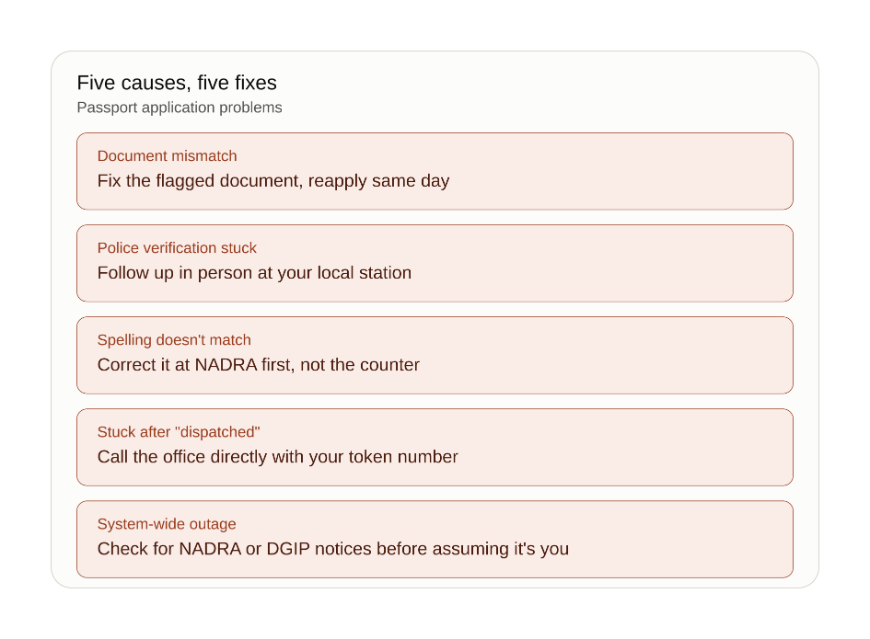
Five causes of passport application problems infographic
Passport Application Problems: Rejected at the Counter
A same-day rejection, before you even get a token, is almost always about paperwork rather than eligibility: an expired CNIC, a photocopy submitted where an original was required, or a missing NOC for government employees. Fix whatever was flagged and go back — there’s no formal appeal for a counter-stage rejection, because your application never technically entered the system in the first place.
That’s actually good news, in a way. There’s no case to reopen, no record that follows you. You correct the one thing that tripped you up and reapply, and it’s as if the first visit never happened. If you’re not sure what a complete application looks like the second time around, the new passport application guide and the documents checklist cover exactly what to bring.
Common Passport Application Problems at the Counter
- CNIC expired or nearing expiry
- Bringing a photocopy where the original was required
- Missing NOC for first-time government employees
- Applying for a minor without both parents’ CNICs or required custody paperwork
Passport Application Problems: Stuck in Police Verification
Some applications — especially first-time ones, or anyone who’s recently changed their registered address — get routed through local police verification before DGIP will approve them. This step happens outside DGIP’s own walls, at the relevant police station, and it’s the single biggest reason applications stretch well past their quoted processing window. If your status has read “under process” for more than three weeks past when you expected it, this is the first thing to ask about — not the printing stage.
It’s also the category most likely to genuinely frustrate people, precisely because DGIP itself can’t speed it up. The delay sits with a different agency entirely.
If you suspect you’re in police verification: showing up at your local station in person, CNIC and application receipt in hand, sometimes moves a stalled case faster than just waiting it out. It’s not a guaranteed fix. But a passive wait rarely resolves a genuinely stuck verification any faster than a direct follow-up would.
Who tends to get routed through this step:
- First-time applicants with a limited identity-document history
- Applicants who recently changed their registered address
- Cases already flagged for manual review during the interview stage
Passport Application Problems: Name or Spelling Doesn’t Match
DGIP pulls your name straight from your CNIC record, so any spelling difference between your CNIC and your old passport, school records, or visa applications is going to surface eventually. Fixing it means updating the CNIC with NADRA first — the passport application itself has no power to override what’s already on file. People who try to get DGIP to “just spell it the old way” usually get sent back rather than corrected on the spot.
This one’s worth handling before it becomes a problem, not after. If your name has ever shown up differently across any official document — even something as small as a middle name appearing on one and missing from another — check your CNIC spelling against everything you’re about to submit before you apply.
Where These Passport Application Problems Come From
Older passports issued before CNIC records were digitized are the usual culprit, back when transliteration wasn’t standardized the way it is now. Whichever spelling is authoritative at NADRA is the one that matters.
Why the Counter Can’t Fix It
That correction has to be settled at NADRA, not at the passport counter — staff genuinely have no authority to reconcile a discrepancy on the spot. Once it’s fixed at the source, it flows through automatically to any application after that.
Passport Application Problems: No Passport After “Dispatched” Status
If your status says “dispatched” or “ready for collection” and a week goes by with nothing in hand, that’s almost always a courier or in-office handling delay — not a processing problem. The passport is already printed. Call the office directly with your token number instead of continuing to refresh the online tracker, since dispatch-stage hiccups don’t always show up in the portal.
This is a fundamentally different kind of delay than the first three. By the time you’re at “dispatched,” your application has cleared every verification stage that could go wrong, and the physical booklet already exists somewhere. What’s left is logistics — getting it from wherever it is into your hands — which is exactly why a phone call beats another tracker refresh at this stage.
When Passport Application Problems Aren’t About You At All
Not every delay traces back to something in your file. Pakistani missions have, at various points, posted notices attributing widespread delays to changes on NADRA’s own side — software updates, fingerprint-matching issues being resolved centrally — that hold up applications across the board, regardless of how clean your paperwork is.
If your timeline is well past normal and none of the four causes above seem to apply, it’s worth checking whether DGIP or your mission has posted any notice about system-wide issues before assuming something is uniquely wrong with your case. The SHIKRA monitoring system is DGIP’s own internal oversight tool for exactly this kind of visibility, and it’s worth knowing it exists even if you can’t access it directly as an applicant.
If your travel date can’t move and your passport genuinely can’t be resolved in time, an Emergency Travel Document is the fallback route for getting home or traveling urgently — worth knowing about even though it’s a different process entirely.
Escalating Passport Application Problems That Won’t Resolve
Once you’ve tried the direct fixes above and you’re still stuck, it’s time to escalate. Overseas Pakistanis can file passport-related complaints by email at complaints.passport@interior.gov.pk, and application-tracking queries specifically can go to opts@dgip.gov.pk — both listed on DGIP’s official site.
DGIP also accepts complaints through the Pakistan Citizen’s Portal, alongside its own helpline and the Regional Passport Office where you applied. If you’re applying from a mission abroad, the Ministry of Foreign Affairs’ passport page covers the same official channels. For a fuller walkthrough of how to escalate and what to expect back, see passport complaint Pakistan.
A word of caution: no official channel gives paid agents faster processing. If someone offers to jump the queue for a fee outside the standard urgent or fast-track tiers, treat that as a red flag, not a shortcut.
What If You Lost Your Token Receipt?
Not every one of these passport application problems involves DGIP or NADRA directly — sometimes it’s just misplaced paperwork on your end. Your CNIC number works just as well as the physical slip for looking up your application — both online and if you’re following up in person at the office. The token receipt is convenient, but it’s not the only way anyone identifies your file.
Does a Rejection Affect Future Applications?
No. A document-related rejection at the counter doesn’t leave any kind of mark on your record — you can reapply the moment the issue is fixed. If you’ve been putting off going back because you’re worried about being flagged for having been turned away once, that worry isn’t necessary.
What Happens to Your Fee If Something Goes Wrong?
This is one of the more overlooked passport application problems — people assume a rejected or abandoned attempt means losing their money outright. It comes up more than you’d expect.
DGIP doesn’t refund passport fees outright, but if your application doesn’t go through, that same payment can be applied toward a future application by the same person — it just has to be verified against the original bank or treasury record. If you’re budgeting around this, the passport fee schedule and paying online pages cover the current tiers so you know what you’re working with either way.
Lost Your Passport? That’s Not a Passport Application Problem — It’s a Different Process
Worth flagging separately: a lost passport application can’t be filed through the normal online renewal flow at all. It requires an in-person visit and a police FIR as the first step — DGIP won’t accept a lost-passport case without one. If that’s your situation rather than a delay on an existing application, the lost, damaged, or exhausted passport guide walks through that process specifically, since it’s genuinely different from everything above.
Frequently Asked Questions About Passport Application Problems
What are the most common passport application problems people run into?
Document mismatches, stuck police verification, spelling errors from CNIC records, dispatch-stage delays, and — this year especially — system-wide technical hiccups on NADRA’s end that have nothing to do with your individual file.
Can I speed up a stuck police verification?
Visiting your local police station in person with your CNIC and application receipt sometimes moves a stalled case faster than waiting for it to clear on its own.
What if my photo gets rejected after I’ve already paid?
You’ll be asked to resubmit a compliant photo at the counter or on a return visit — the fee itself doesn’t need to be paid again for a photo-only issue.
Is there a formal complaint process for long delays?
Yes — email complaints.passport@interior.gov.pk if you’re overseas, or use the Pakistan Citizen’s Portal, DGIP’s helpline, or your Regional Passport Office directly.
Can a lawyer or agent fix a stuck application faster?
No official channel gives paid agents faster processing — any claim to bypass the queue for a fee should be treated as a red flag, not a shortcut.
What if I lost my token receipt?
Your CNIC number can be used to look up your application status even without the physical token slip.
Does a rejected application affect future applications?
No — a document-related rejection at the counter doesn’t create a negative record, and you can reapply as soon as the issue is corrected.
Do I get my fee back if my application fails?
Not as a direct refund, but the same fee can generally be applied toward a future application once it’s verified against the original payment record.
Passport Application Problems: Bottom Line
Nearly every one of the passport application problems people run into fits into one of five buckets — a document issue, a stuck police verification, a CNIC spelling mismatch, a dispatch-stage handling delay, or a system-wide technical hiccup that isn’t about you at all. Working out which one applies to your situation, and going straight to the right fix, beats refreshing the tracker and hoping for the best every time.