Application · Updated August 2026 · Last verified August 2026
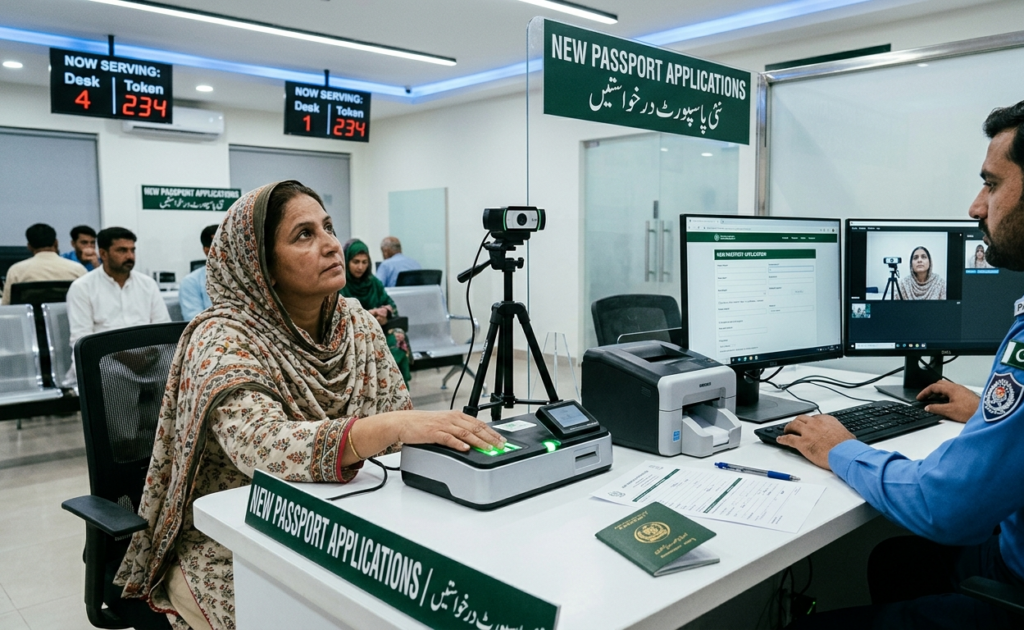
Quick Answer
For a new Pakistani passport application, bring a valid CNIC (or B Form for minors) and a paid fee challan to a Regional Passport Office. You’ll get a token, have biometrics captured, go through a short interview, then wait for printing. The process is the same fixed sequence for almost everyone, whether you’re applying for the very first time as an adult or bringing in a child’s documents on their behalf, and most of what separates a smooth new Pakistani passport application from a delayed one comes down to whether your paperwork matches across CNIC, NADRA, and any prior travel documents before you ever reach the counter.
Documents You’ll Need for a New Pakistani Passport Application
Adults
- Original CNIC/Smart CNIC plus photocopy
- Paid fee challan
- Old passport, if any
- NOC for first time government employees
Minors (Under 18)
- Child’s B Form or Smart Card
- Both parents’ CNICs plus copies
- One parent/guardian present in person
- Custody papers if parents are separated
These lists cover the great majority of cases, but a new Pakistani passport application for a minor tends to move more smoothly when both parents’ documents are gathered in advance, since the office will not proceed without the required guardian paperwork on the day.
Newborn Passports (Under 2 Years), Applying From Abroad
If your baby is under two years old and you’re applying from outside Pakistan, DGIP’s online portal has a dedicated “New” application category built specifically for newborns. You don’t need to start the process with an in person mission visit. You’ll still need the child’s B Form/CRC, both parents’ CNIC or NICOP, and the required photograph and biometric consent, submitted through the online overseas passport portal.
If your child is already over two years old, this online newborn category isn’t available. A new Pakistani passport application for a child past that age needs to be filed in person at your nearest Pakistani mission instead, along with the standard supporting documents for minors listed above. This distinction catches some overseas parents off guard, since the age cutoff applies strictly at the point of application, not at the point the child was born or first documented.
Step by Step Process for a New Pakistani Passport Application
This follows DGIP’s own application workflow; see the official passport application process page for the current version.
- Pay the fee. Scan the token’s QR code via JazzCash/Easypaisa or mobile banking. Cash and bank counter payment ended July 2026.
- Visit the office. Bring originals and copies to the counter.
- Get your token. Check details on it immediately.
- Biometrics. Photo, fingerprints, digital signature.
- Interview. Identity and citizenship verification.
- Printing. Track by SMS or the online portal until dispatch.
Each of these six steps applies whether this is your first ever passport or you’re applying new for some other reason, and the order doesn’t change based on age, location, or whether you’re applying inside Pakistan or through a mission abroad. What can change is how long any single step takes, particularly the interview stage, which is where most delays in a new Pakistani passport application actually surface.
Practical Note
The single biggest cause of a rejected token in a new Pakistani passport application is a CNIC that’s expired or has a spelling mismatch with other records. Renew and cross check your CNIC at NADRA before booking your visit, not after. Applicants sometimes assume a small transliteration difference, such as a middle name spelled slightly differently between an old document and a current CNIC, won’t matter. In practice, it’s exactly this kind of mismatch that most often stalls an application before it even reaches the interview stage.
If Your Case Gets Referred for Further Verification
Not every application clears the interview stage immediately. Cases involving a name discrepancy across documents, a first time application with no prior CNIC history, or a dual nationality declaration are sometimes referred to a senior officer for manual review. This adds days, not weeks, in most cases, but it means your token status will show “under process” for longer than the standard timeline. It’s not a rejection; treat it as a normal extra verification step unless you’re contacted for missing documents.
This referral path exists precisely because a new Pakistani passport application, by definition, often involves less document history for DGIP to check against than a renewal would. A first time applicant simply has less of a paper trail on file, so a manual review is a routine safeguard rather than a sign that something has gone wrong with your case.
If You’re Flagged on ECL or BL (Exit Control List / Blacklist)
As part of the in office verification step, DGIP checks every applicant against the Exit Control List (ECL) and the passport Black List before the case reaches the interviewing officer’s decision counter. If your name appears on either list, your application is paused right there, not rejected, but held until the listing is resolved. This is a Ministry of Interior restriction, not something front desk passport staff can explain or resolve, so raising it at the counter won’t move things along. If you believe you’re wrongly listed, you’ll need to contact DGIP’s Passport Control List / Black list query channel directly, with your full name, father’s/guardian’s name, CNIC number, and place of birth.
Because this check happens automatically and applies to every application regardless of whether it’s a first time submission or a renewal, it’s worth understanding that a pause here says nothing about the quality of your paperwork. It’s a separate system entirely from the document and biometric verification the rest of this guide covers.
Once you know your documents, the next step is to check what the application will cost; see our passport fee schedule.
Frequently Asked Questions
Can someone else submit my application? No. Biometric capture requires your physical presence, so a new Pakistani passport application can’t be submitted entirely on your behalf by a friend or relative, even with your documents in hand.
What if my child has no B Form yet? Get one from NADRA first; it’s required for the passport application. There’s no way around this step, since the B Form is the underlying identity record the passport application draws from for a minor.
Do government employees need extra paperwork? Yes, a departmental NOC is required for first time applicants. This applies specifically to a new Pakistani passport application from someone in government service who hasn’t held a passport before; it isn’t a general requirement for every applicant.
What if I don’t have an old passport and this is my first one? That’s normal for first time applicants; just bring your CNIC and B Form/CRC history. No prior passport is required to apply, and the absence of one shouldn’t be treated as a red flag or an unusual circumstance by office staff.
Can I apply at any Regional Passport Office, or only one near my CNIC address? Yes, at any RPO nationwide; under Passport Rule 6 (2021), you can apply irrespective of the address on your CNIC/NICOP/CRC. Your local office is usually still faster, since it’s less likely to be handling out of district backlog cases. See our regional office directory to find one near you.
How long is the whole process, start to finish? For normal processing, expect the in office steps (token, biometrics, interview) to take under an hour, with printing and dispatch adding the 21 working days from the fee schedule; faster if you choose urgent (5 working days) or fast track (2 working days, MRP only) instead. A new Pakistani passport application doesn’t carry a different official timeline from a renewal once it clears the interview stage; the printing and dispatch windows are the same either way.
What does it mean if my application is paused for ECL/BL verification? It means DGIP’s records show a possible match against the Exit Control List or the passport Black List during the standard verification step every applicant goes through. Your case is held, not rejected, until the listing is resolved with the Ministry of Interior directly; the passport office itself can’t clear it for you at the counter.
Bottom Line
Most applications move through token, biometrics, interview, and printing without a hitch. The referral and ECL/BL scenarios above are the exception, not the rule, but knowing what they look like in advance means you won’t mistake a routine extra verification step for a rejection. Whether you’re filing a new Pakistani passport application for yourself, applying on behalf of a minor, or handling a newborn’s documents from abroad, the underlying sequence stays the same, and the paperwork you bring on day one is still the single biggest factor in how smoothly it goes.
For more passport guides, visit Zippify.