Travel · Updated August 2026 — Last verified August 2026
Quick Answer
Yes: the Saudi eVisa for Pakistani citizens is available through a specific exception, not the standard nationality list. Pakistan isn’t among the 66+ countries eligible for Saudi Arabia’s tourist eVisa by nationality alone, but if you hold a valid US, UK, or Schengen visa that’s been used at least once, you qualify to apply through the same official eVisa portal (visa.visitsaudi.com) as those 66 nationalities — multiple entry, valid one year, up to 90 days per visit. Without a qualifying foreign visa, Pakistanis use a different, more limited route through Tasheer visa facilitation centres instead.
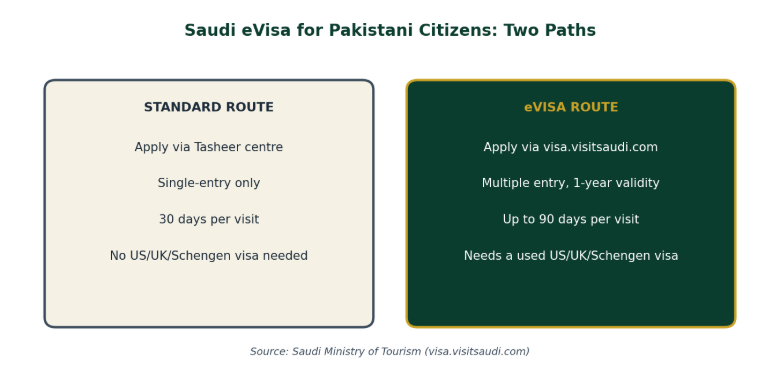
Saudi eVisa for Pakistani citizens — the standard route versus the US/UK/Schengen exception route.
Do You Qualify for the Saudi eVisa as a Pakistani Citizen?
The Saudi eVisa for Pakistani citizens exception applies if any of the following applies to you:
- You hold a valid US visitor/business visa that has been used at least once (has an entry stamp) — an unused, never-traveled-on visa doesn’t count.
- You hold a valid UK visit or business visa, used at least once.
- You hold a valid Schengen visa issued by any member state, used at least once.
- You hold permanent residency in the US, UK, or EU.
- You hold eligible dual citizenship in a country that’s on the standard 66+ nationality eVisa list.
If none of these apply, you still have a path into Saudi Arabia for tourism or Umrah — it’s just the standard Pakistani route through Tasheer centres, not the Saudi eVisa for Pakistani citizens exception route.
“Valid and Used” — What That Actually Means
This is the detail that trips people up about the Saudi eVisa for Pakistani citizens exception: your US, UK, or Schengen visa has to be both currently valid (not expired) and show evidence you’ve actually entered that country on it — typically an entry or exit stamp, or a digital entry record for countries that don’t stamp passports. A visa you were granted but never traveled on doesn’t satisfy the requirement, even if it’s technically still valid on the sticker or approval letter.
How the eVisa Compares to the Standard Pakistani Route
Without a qualifying foreign visa, Pakistani applicants go through Tasheer visa facilitation centres (available in Islamabad, Lahore, Karachi, Peshawar, Quetta, and Multan) instead of the online eVisa portal used for the Saudi eVisa for Pakistani citizens exception. As of the last policy update, that standard route issues single-entry visas valid for 30 days only — a meaningfully more limited product than what a qualifying foreign visa unlocks: multiple entries across a full year, with up to 90 days allowed per visit.
How to Apply
The application steps for the Saudi eVisa for Pakistani citizens are the same as for any other eligible applicant on the official portal:
1. Confirm your US, UK, or Schengen visa is valid and has at least one entry/exit stamp or travel record on it.
2. Go to the official portal, visa.visitsaudi.com — not a third-party site.
3. Create an account and complete the application, entering your Pakistani passport details and your qualifying US/UK/Schengen visa details for the Saudi eVisa for Pakistani citizens exception.
4. Upload a passport scan, a recent photo, and evidence of your foreign visa (the visa page/stamp).
5. Pay the eVisa fee online and submit.
6. Wait for approval — often within minutes to 24 hours, occasionally longer during Ramadan or Hajj season.
⚠ Know Which Platforms Are Actually Official
Two Saudi government platforms handle the Saudi eVisa for Pakistani citizens and other applicants: visa.visitsaudi.com (Ministry of Tourism, tourist eVisa) and ksavisa.sa (Saudi Arabia’s unified visa platform, launched 2023, covering a broader range of visa types). Both are legitimate. What isn’t legitimate: private “visa assistance” sites with names like saudi-visa.org or saudiarabiavisaonline.com, often registered outside Saudi Arabia, that charge a markup for a service the government platforms provide directly. Before paying any fee, confirm you’re on an official .sa government domain, and never enter passport or payment details anywhere else.
Why the eVisa Option Can Seem to Turn On and Off
If you successfully got the Saudi eVisa for Pakistani citizens exception before, then found the option gone, and now it’s back again — that’s a real, documented pattern, not a glitch or something you misremembered. Saudi Arabia periodically applies temporary, seasonal restrictions on specific nationalities, including Pakistan, for visit and Umrah-related visas, most often in the run-up to Hajj season, as an operational measure to manage crowd size and processing capacity rather than a permanent policy change. The eVisa for Pakistani citizens with a qualifying US, UK, or Schengen visa has followed this same on-again, off-again pattern at points in 2024 through 2026.
One honest limitation worth naming: no static guide, including this one, can tell you whether other applicants have recently succeeded on a specific platform this week — that’s the kind of real-time detail that changes faster than any article can track. What we can tell you is how to reduce your risk regardless: confirm you’re on an official .sa domain, avoid paying anything before the application is actually submitted and confirmed, and cross-check current eligibility on the platform itself immediately before paying rather than relying on a past successful application as proof it still works today.
What the eVisa Covers (and Doesn’t)
The Saudi eVisa for Pakistani citizens covers a specific set of activities, not everything:
- Covers: tourism, visiting friends and relatives, business meetings and events, and Umrah (outside the Hajj period).
- Does not cover: the Hajj pilgrimage itself, which requires a separate, dedicated Hajj visa regardless of what other visas you hold.
- Does not cover: paid employment or long-term study, which need their own sponsored visa categories.
If Hajj is what you’re actually planning for, see our guide to renewing your passport in Saudi Arabia, which also covers early renewal for Hajj 2027 pilgrims.
Cost and Validity
Once approved, the Saudi eVisa for Pakistani citizens comes with the same terms as the standard eVisa:
- Validity: multiple entry, one year from issue date, up to 90 days per individual visit.
Cost: this isn’t one flat number, and that’s worth knowing before you pay. On visa.visitsaudi.com, the total commonly cited is around SAR 500–535, but it’s actually three separate charges stacked together — a base visa fee (around SAR 300), mandatory medical insurance (roughly SAR 95–180, depending on which provider you’re assigned), and VAT/transaction fees. ksavisa.sa itemizes or bundles these differently, and travelers have reported total charges well below SAR 500 on that platform — so don’t treat any single number here as fixed. Check the actual checkout total on whichever official platform you’re using immediately before paying.
- Passport validity: your Pakistani passport needs at least six months of validity remaining from your date of entry, the same six-month rule that applies to most international travel.
Practical Note
The six-month passport validity rule catches Saudi eVisa for Pakistani citizens applicants off guard more often than almost anything else in this process, precisely because it’s easy to overlook when you’re focused on the foreign-visa eligibility requirement. Check your Pakistani passport’s expiry date before you even start the eVisa application — if you’re inside that six-month window, renewing first will save you a rejected or wasted application. See our passport renewal guide or, if you’re applying from inside Saudi Arabia already, our Saudi Arabia renewal guide for the process.
Frequently Asked Questions
Does my US or Schengen visa need to still be valid, or can it be expired?
For the Saudi eVisa for Pakistani citizens exception, it needs to be currently valid (not expired) at the time you apply, and it needs to have been used at least once — an expired-but-previously-used visa doesn’t qualify, and neither does a valid-but-never-used one.
Can I use a UK visa instead of a US or Schengen visa?
Yes — a valid, previously-used UK visit or business visa qualifies on the same basis as a US or Schengen visa for this exception.
What if I don’t have a US, UK, or Schengen visa at all?
You can still travel to Saudi Arabia for tourism or Umrah — you’d apply through Tasheer visa facilitation centres instead of the Saudi eVisa for Pakistani citizens route, though that route currently issues single-entry visas valid for 30 days, rather than the eVisa’s multiple-entry, one-year terms.
Is the Saudi eVisa for Pakistani citizens valid for Hajj?
No — the eVisa explicitly excludes Hajj. It covers Umrah outside the Hajj period, tourism, and business/family visits, but Hajj requires its own dedicated visa process.
Is ksavisa.sa a legitimate site, or should I only use visa.visitsaudi.com?
Both are legitimate Saudi government platforms — visa.visitsaudi.com is the Ministry of Tourism’s eVisa portal, and ksavisa.sa is Saudi Arabia’s unified visa platform launched in 2023 covering a wider range of visa types. Watch out instead for private visa-assistance sites with no .sa domain that charge a markup for the same service.
Why did the Saudi eVisa option for Pakistani citizens seem to disappear and then come back?
This matches a real, documented pattern — Saudi Arabia periodically applies temporary, seasonal restrictions on specific nationalities, including Pakistan, for visit and Umrah visas, most often ahead of Hajj season, as an operational crowd-management measure rather than a permanent change. If you’re seeing the option again now, that’s consistent with a previous seasonal restriction having lifted.
How do I know if other applicants have recently succeeded on a given platform?
No static guide can confirm this in real time — success rates and platform availability shift week to week. The safer approach is verifying you’re on an official .sa domain, not paying until your application is actually submitted, and treating a past successful application as encouraging but not proof the process works identically today.
How long does approval take?
Often within minutes to 24 hours for straightforward applications, though it can take longer during high-volume periods like Ramadan or the Umrah season.
Bottom Line
The Saudi eVisa for Pakistani citizens isn’t available by nationality alone, but the US/UK/Schengen visa exception is a real, well-established pathway that gets you a far better visa than the standard Tasheer route — multiple entries over a full year instead of one 30-day trip. If you already hold and have used one of those visas, applying for the Saudi eVisa for Pakistani citizens through the official portal is usually faster and simpler than the alternative; if you don’t, the Tasheer route remains your standard option for now.